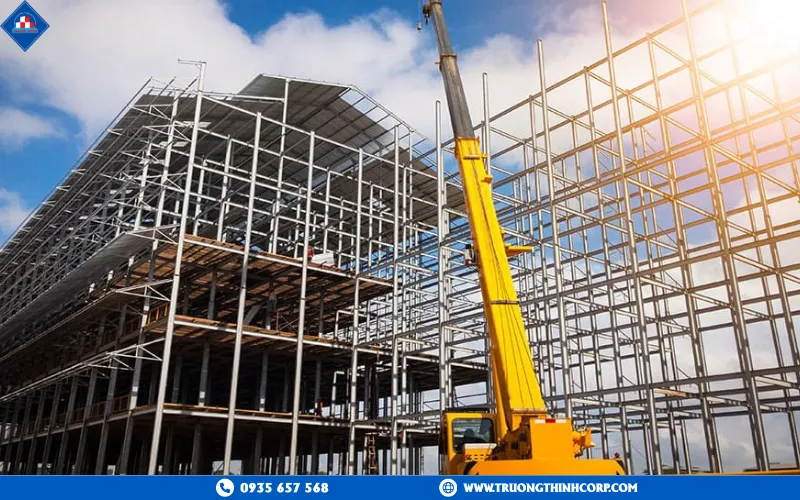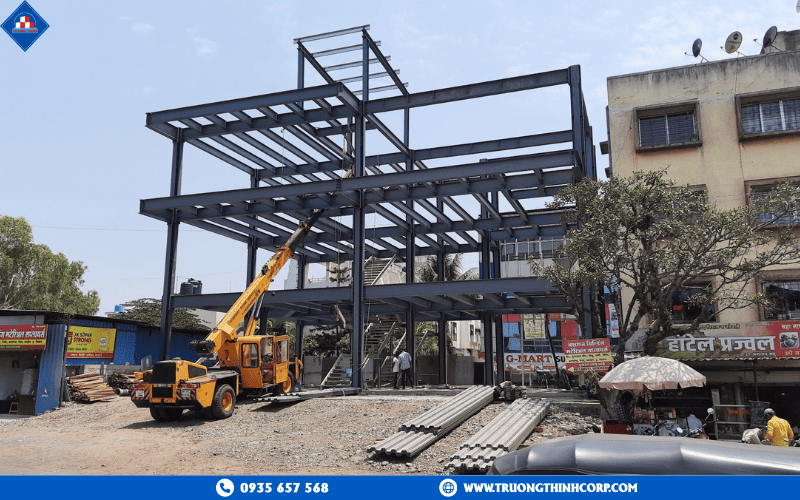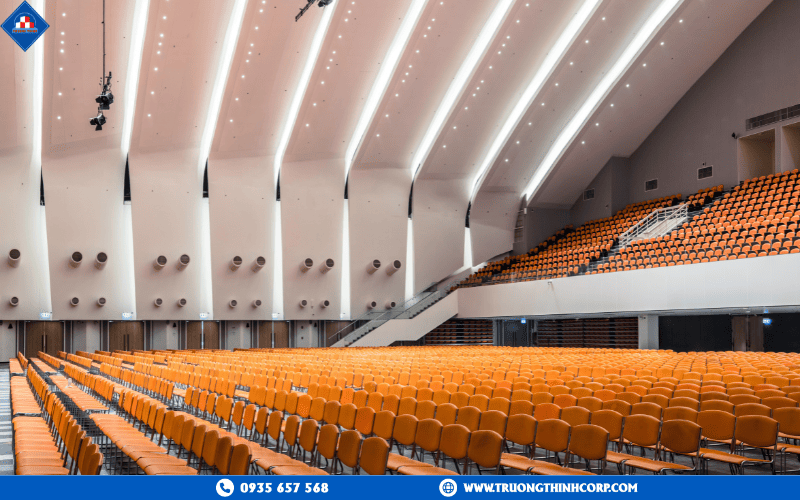


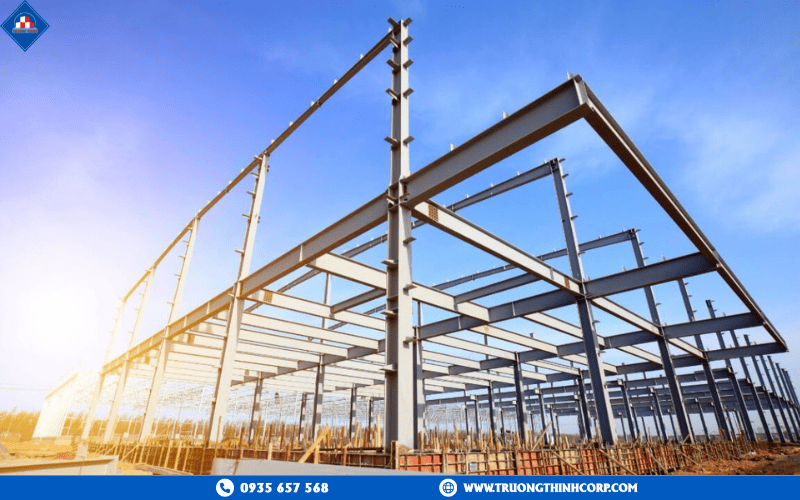
Prefabrication is a delivery method, not a building type — it can produce a warehouse, a dormitory wing, or a villa’s frame, and the building types above already cover what those look like structurally. What actually distinguishes steel structures in prefabricated building construction as its own subject is everything that happens before the frame reaches site: how a module is sized to fit a truck, how factory tolerance is held tight enough that bolted joints line up on the first try, and how fabrication schedule is sequenced against transport and crane availability.
1. Module sizing is constrained by the road, not the design
A prefabricated steel module can only be as large as it can legally and physically travel from factory to site. That constraint, more than architectural preference, sets the maximum module dimensions before design even starts.
1.1 Transport envelope drives the module split
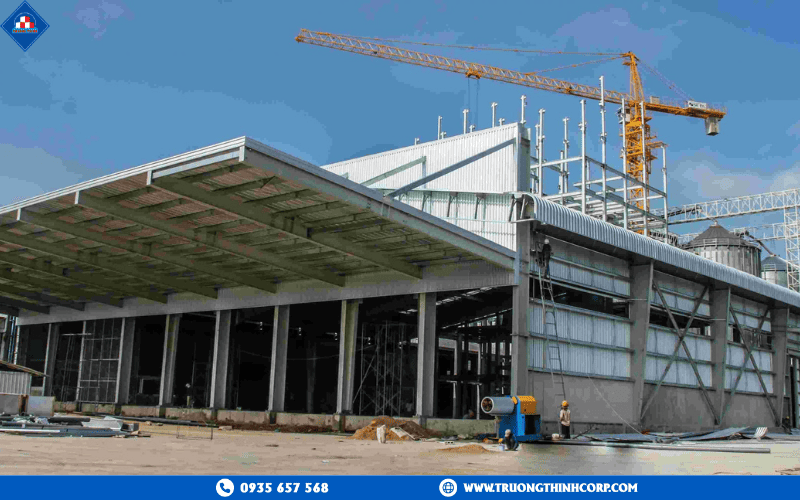
Truong Thinh Corp checks route width, bridge clearance, and turning radius from factory to site before finalizing how a structure is divided into shippable modules — a large single-piece frame that cannot physically travel the route has to be split and rejoined on site, which changes the connection design.
1.2 Heavy sections versus light framing changes the shipping math
H-beam and I-beam sections for industrial spans ship differently than light-gauge residential framing — different truck counts, different loading sequences, different crane capacity needed at the site end. Truong Thinh Corp plans logistics around which system the project uses rather than a one-size shipping plan.
1.3 Export projects add customs and containerization constraints
For steel structures shipped overseas, module dimensions also have to fit standard shipping containers or break-bulk vessel space, and documentation has to clear customs on both ends. Truong Thinh Corp builds this into the fabrication schedule for export clients from the start, not as a shipping-department problem solved after production.
2. Holding tolerance so bolted connections actually line up
The entire economic case for prefabrication collapses if modules do not fit together cleanly on site — rework at that stage is slower and more expensive than the same fix would have been in the factory.
2.1 CNC-cut and pre-drilled connection points
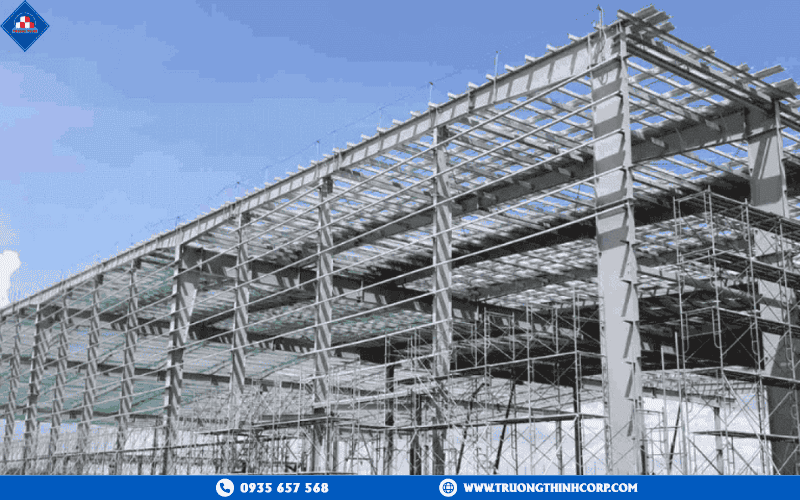
Truong Thinh Corp cuts and drills bolt holes by CNC machine to a tolerance tight enough that field bolting does not require re-drilling — the accuracy is built in at the factory stage precisely so the site crew’s job is simple, repeatable bolting rather than fitting adjustment.
2.2 Trial assembly before shipment
For complex or high-value projects, Truong Thinh Corp trial-fits modules at the factory before they ship, catching any misalignment while it is still cheap and fast to correct — a step that is far harder to justify skipping once modules are already on a truck.
2.3 Consistent quality across every production run
Because a prefabricated project can involve dozens of near-identical modules produced over weeks, Truong Thinh Corp verifies steel grade — SS400, Q345B, and similar — and coating quality on every production batch, not just the first one, so module 40 fits as precisely as module 1.
3. Sequencing factory output against site readiness
Prefabrication only saves time if fabrication finishes exactly when the site is ready to receive modules — either extreme, producing too early or too late, costs money.
3.1 Just-in-time delivery avoids site storage problems
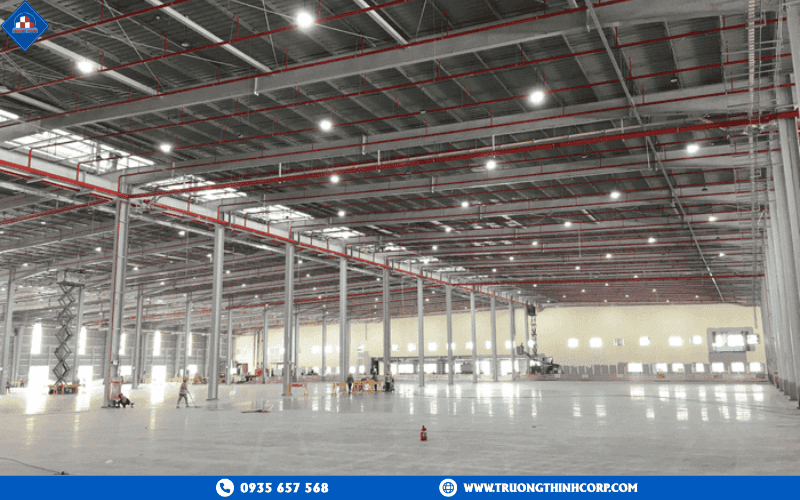
Modules stored too long on a congested site risk damage and eat up laydown space needed for other trades. Truong Thinh Corp sequences fabrication and delivery so modules arrive close to their erection date rather than stockpiling early.
3.2 Crane capacity sets the maximum module weight
The heaviest single module in the design has to match what the site’s planned crane can actually lift at the required reach — a constraint that Truong Thinh Corp checks against the crane plan before finalizing module weight, not after fabrication is complete.
3.3 Fireproofing and insulation applied at the right stage
Fire-resistant board, thermal insulation, and acoustic treatment can be applied at the factory for some module types and only on site for others, depending on whether the finish would be damaged in transport — Truong Thinh Corp decides this per project rather than defaulting to one approach.
4. Choosing a prefabrication partner and starting the project
Because so much of a prefabricated project’s success is decided before steel ever reaches site, supplier evaluation should focus on factory and logistics capability as much as design.
4.1 What to check in a supplier
Factory capacity, CNC and welding certification, and compliance with ISO or ASTM standards all matter — Truong Thinh Corp runs design, fabrication, and installation as one integrated workflow so tolerance and schedule stay controlled end to end rather than handed off between separate parties.
4.2 Questions worth asking before signing
Warranty terms, trial-assembly practice, delivery schedule commitments, and how the contractor handles a route or crane constraint discovered mid-project are the questions that separate a smooth prefabricated build from a delayed one.
4.3 A simple three-step start
Design consultation to fix technical requirements and module strategy, a detailed cost and logistics estimate, then a manufacturing and installation contract — keeping this sequence in order avoids the common mistake of finalizing a design before checking whether it can actually be transported and lifted.
Prefabrication earns its speed advantage in the factory and on the transport route, not just on site. Truong Thinh Corp plans module sizing against real transport and crane constraints, holds tolerance tight enough that bolting is the only site work required, and sequences delivery to match your project’s actual readiness.
Building with prefabricated steel?
Truong Thinh Corp fabricates precise, ready-to-assemble steel structures for prefabricated buildings of every type — delivered fast and built to last. Send your project for a free quotation.
Frequently Asked Questions
What limits how large a prefabricated steel module can be?
Transport route width, bridge clearance, turning radius, and — for exports — container dimensions set the practical ceiling on module size before design even begins.
How is site fit-up quality guaranteed if the frame is built off-site?
Through CNC-cut, pre-drilled connection points held to tight tolerance, and trial assembly at the factory for complex projects before modules ever ship.
What buildings suit prefabricated steel structures?
Any building type where speed and predictable quality matter — factories, warehouses, dormitories, showrooms, and villa frames alike all use the same prefabrication method, just different module designs.
Does Truong Thinh export prefabricated steel buildings?
Yes. We fabricate in Vietnam and export complete prefabricated steel packages with logistics, containerization, and technical support handled end to end.