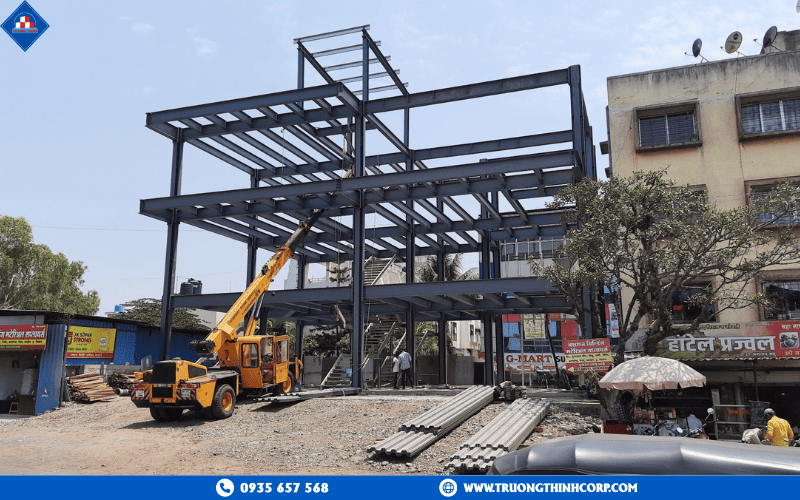


Past roughly twenty floors, a building’s structural problem stops being “carry the load” and becomes “control the sway.” Wind and seismic forces that a low-rise building barely notices accumulate over height into lateral drift that has to stay within a range occupants don’t feel and finishes don’t crack under — and that single constraint is what shapes almost every decision in steel structures for high-rise buildings.
1. Why lateral drift, not gravity load, governs high-rise steel design
A ground floor column in a forty-story tower carries a predictable, calculable gravity load. What is harder to predict — and what actually sizes the structure — is how far the top of the building sways under wind or seismic force, because excessive drift cracks partitions, unsettles elevators, and simply feels wrong to people standing in it.
1.1 Lighter steel means less lateral force to begin with
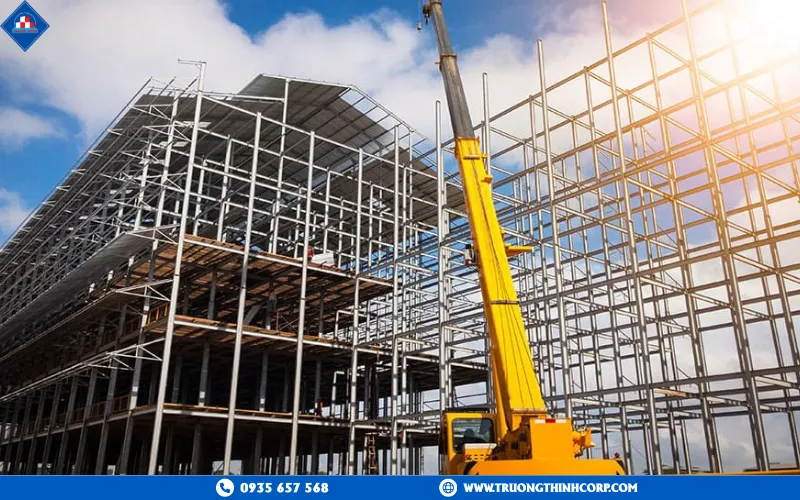
Because steel weighs a fraction of an equivalent concrete structure, a steel-framed tower generates lower seismic force in the first place — seismic load scales with mass, so a lighter building shakes less hard under the same ground motion. Truong Thinh Corp uses this weight advantage as the starting point for lateral system design, not an afterthought.
1.2 Bracing and core systems are what actually control sway
A steel frame alone rarely controls drift at height on its own; X-braces, V-braces, or a braced/moment-frame combination working with the building’s core absorb and redirect lateral force. Truong Thinh Corp selects the bracing pattern per floor based on where drift needs the most control, typically increasing bracing density toward the base where cumulative sway is greatest.
1.3 Differential column shortening between composite and steel elements
In towers that mix concrete-filled steel tube columns with a steel-framed core, the two systems shorten under load at slightly different rates as the building rises — a detail that, if ignored, telegraphs into floor slabs as unevenness over decades. Truong Thinh Corp accounts for this differential shortening in the design rather than treating all vertical elements as behaving identically.
2. How steel and concrete combine at height
Very few tall towers are pure steel or pure concrete — the efficient answer is usually a composite system that puts each material where it performs best.
2.1 Concrete-filled steel tube columns at the base
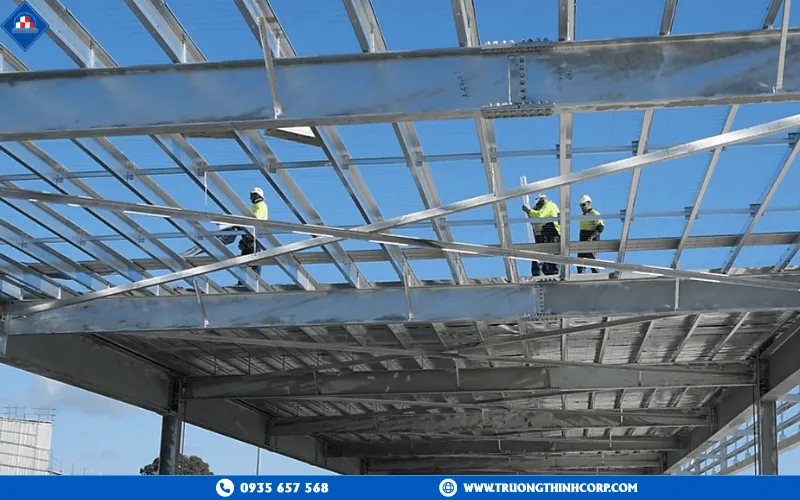
Where vertical load is most concentrated — the lowest floors, carrying everything above — steel columns filled with concrete combine the steel tube’s tensile strength and ductility with the concrete core’s compressive strength and fire resistance, holding a compact column profile even under the heaviest load in the building.
2.2 Composite floors that cut weight without cutting stiffness
Steel deck with a thin concrete topping weighs less than a fully cast floor slab and installs faster, and — because seismic force scales with mass — every floor’s weight saved compounds into a smaller lateral force the whole building has to resist. Truong Thinh Corp sizes deck and topping to hit a stiffness target for occupant comfort, not just a strength minimum.
2.3 The concrete core as the building’s spine
Elevator and stair cores, typically reinforced concrete, usually carry the largest share of lateral load in a composite high-rise, with the steel frame around it handling gravity load and freeing up the open floor plates tenants want. Truong Thinh Corp coordinates steel frame design tightly with the core so the two systems share lateral load the way the analysis model assumes, not by accident.
3. Where the real cost trade-off sits in a tall building
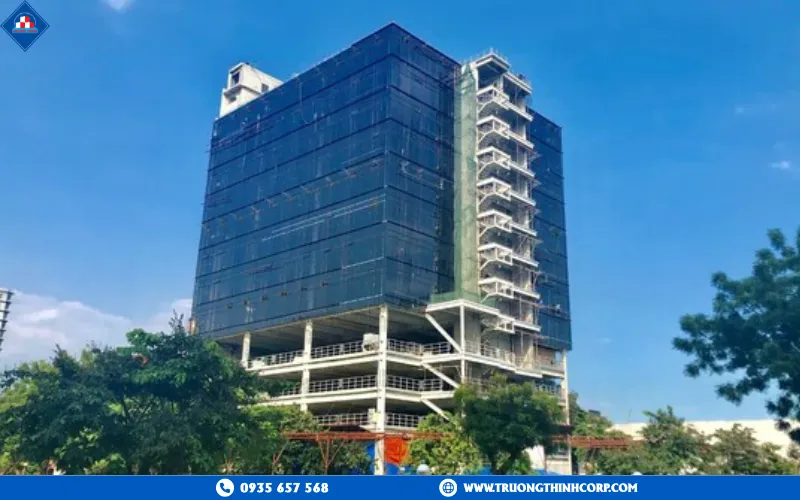
Steel’s material cost per ton is often higher than concrete’s — the case for steel at height is made in the foundation, the schedule, and the floor area, not the steel invoice alone.
3.1 Foundation savings scale with height
A lighter steel-framed tower reduces the load reaching the foundation, and that saving compounds with every additional floor — the taller the building, the more a foundation designed for a lighter structure is worth. Truong Thinh Corp quantifies this trade-off against the specific soil conditions of the site rather than a generic percentage.
3.2 Floor-by-floor erection compresses the schedule
Prefabricated steel members erect in a repeatable floor-by-floor sequence that does not wait on concrete curing time between levels, which is where most of the schedule advantage over cast-in-place concrete actually comes from on a fifty-story building.
3.3 Slimmer columns recover sellable or leasable floor area
Every centimeter a column shrinks multiplied across dozens of floors adds up to real leasable or sellable area — a return that shows up in the developer’s revenue model, not in the structural budget line, which is why it is easy to undervalue when comparing steel and concrete on material cost alone.
3.4 Project-specific structural optimization
Truong Thinh Corp runs project-specific analysis to select efficient beam and column profiles and connection details for each tower’s height, wind exposure, and seismic zone, rather than applying a standard scheme regardless of site — a fifty-story coastal tower and a twenty-story inland building do not carry the same lateral design problem.
Above twenty floors, the structural question shifts from strength to sway — and getting that lateral behavior right is what separates a high-rise steel design from a scaled-up mid-rise one. Truong Thinh Corp designs the bracing, composite column, and core coordination that tall buildings specifically require, backed by project-specific lateral analysis for your site’s wind and seismic conditions.
Developing a high-rise building?
Truong Thinh Corp provides design, consulting and fabrication for high-rise steel buildings — optimizing weight, speed and safety. Get a free consultation with our engineers.
Frequently Asked Questions
Why does drift matter more than strength in high-rise steel design?
Above roughly twenty floors, wind and seismic sway accumulates enough to crack finishes and unsettle occupants well before the structure approaches its strength limit — so bracing and stiffness govern the design.
Are steel high-rises safe in earthquakes and high winds?
Yes. Steel’s lighter weight reduces the seismic force the building attracts, and its ductility lets the frame flex under load rather than crack — a combination reinforced concrete alone does not match as efficiently at height.
Why combine steel with concrete instead of using pure steel?
Concrete-filled steel tube columns and a concrete core each do what they’re best at — compressive strength and fire resistance from concrete, tensile strength and ductility from steel — giving a more efficient structure than either material alone.
Can Truong Thinh handle high-rise design and fabrication?
Yes. We deliver end-to-end lateral analysis, design and fabrication for tall buildings, coordinated against your project’s specific wind, seismic and soil conditions.