

Choosing the right steel structure manufacturer in Vietnam is one of the most consequential decisions in any pre-engineered building, factory, or warehouse project: this guide covers what international buyers should verify before ordering, how Truong Thinh Corp’s Ho Chi Minh City fabrication process works end to end, and how the numbers compare against sourcing locally or from a less specialized supplier. Fabrication quality, mill-certified steel, welding standards, and delivery discipline determine whether a project finishes on schedule or spends months fighting rework and customs delays.
1. Why International Buyers Source Steel Structures from Vietnam
Vietnam has become a preferred sourcing base for pre-engineered steel buildings and structural steel components for three practical reasons: competitive fabrication cost relative to Japan, Korea, and Australia; a mature welding and heavy-fabrication workforce built up over two decades of FDI-driven industrial construction; and port access from Ho Chi Minh City that puts Southeast Asian buyers within a manageable shipping window, with export logistics extending to more distant markets as demand grows.
The gap between suppliers is in process control. A steel structure factory without a documented QC system, calibrated cutting equipment, and export experience will produce inconsistent tolerances that cost far more to fix on site than they saved on the unit price.
2. Inside Truong Thinh’s Steel Structure Manufacturing Facility
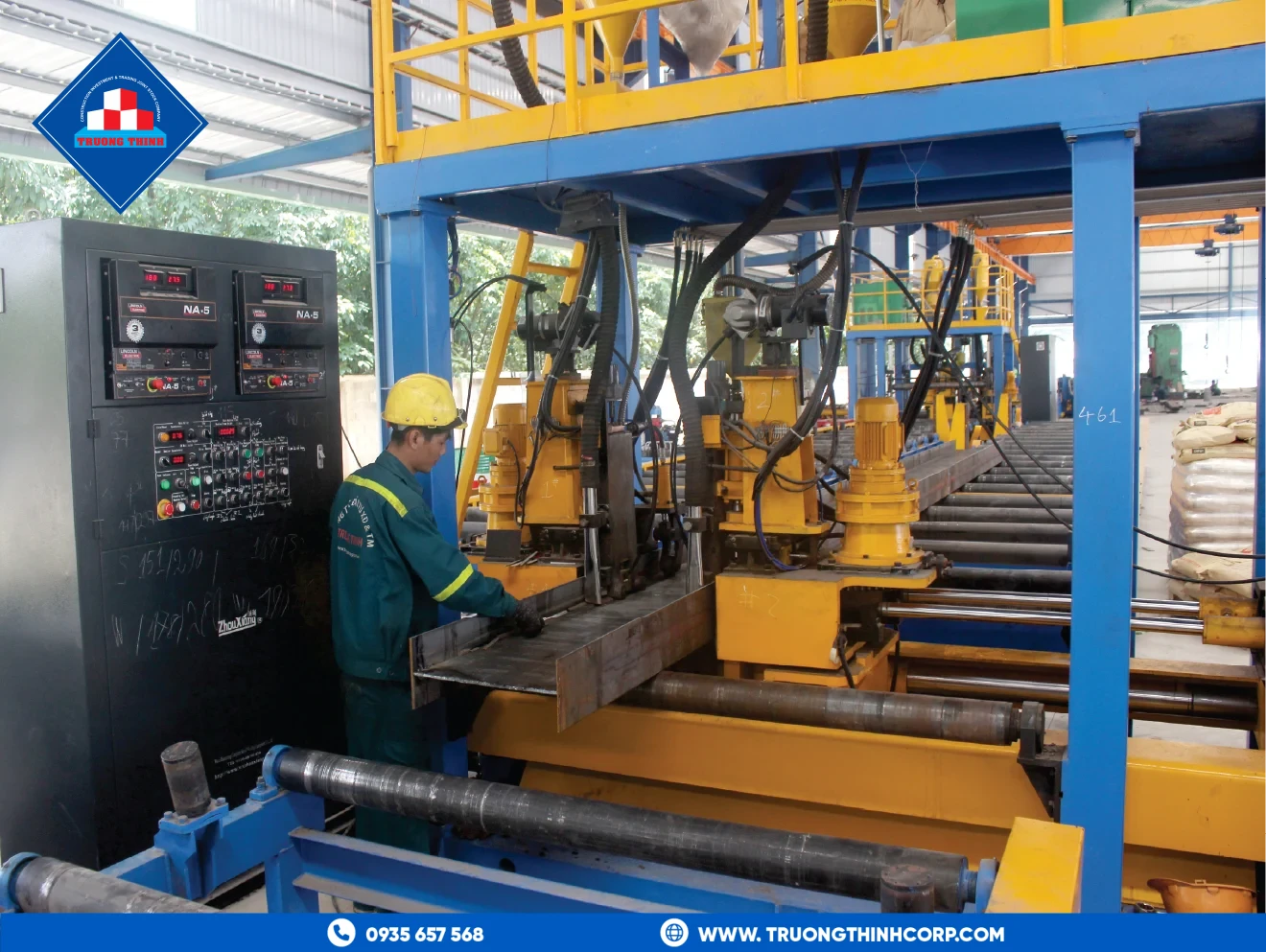
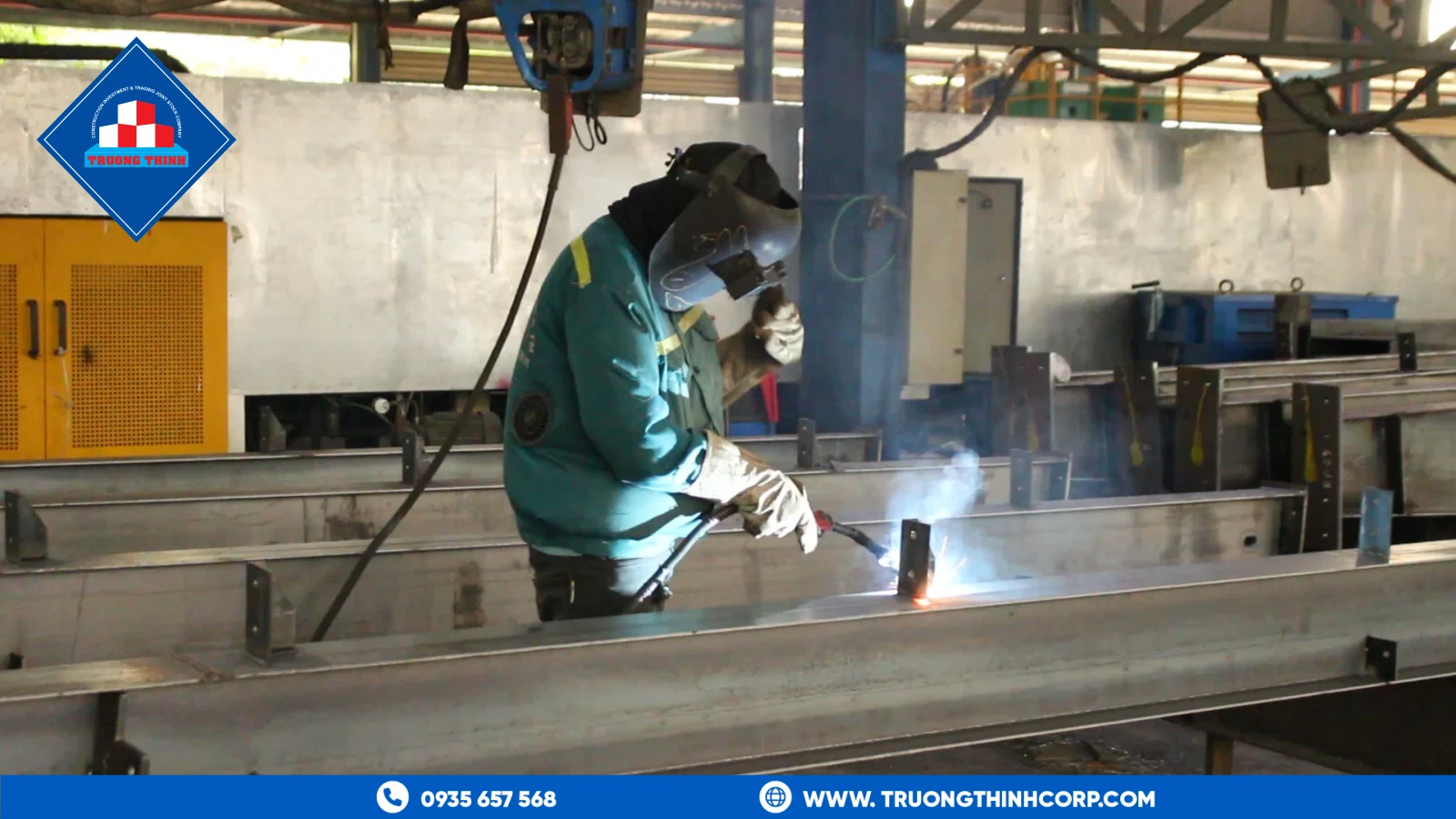
Truong Thinh operates a 25,000 m² manufacturing facility outside Ho Chi Minh City, split between a 15,000 m² covered workshop and 10,000 m² of yard and office space for staging, loading, and finished-goods storage. The plant is organized as a continuous fabrication line: raw steel plate and section intake, CNC plasma and laser cutting, automatic and horizontal welding lines, a beam-straightening machine for camber and twist correction, Sa 2.5 abrasive blast cleaning, and a paint/primer finishing bay before crating and export packing.
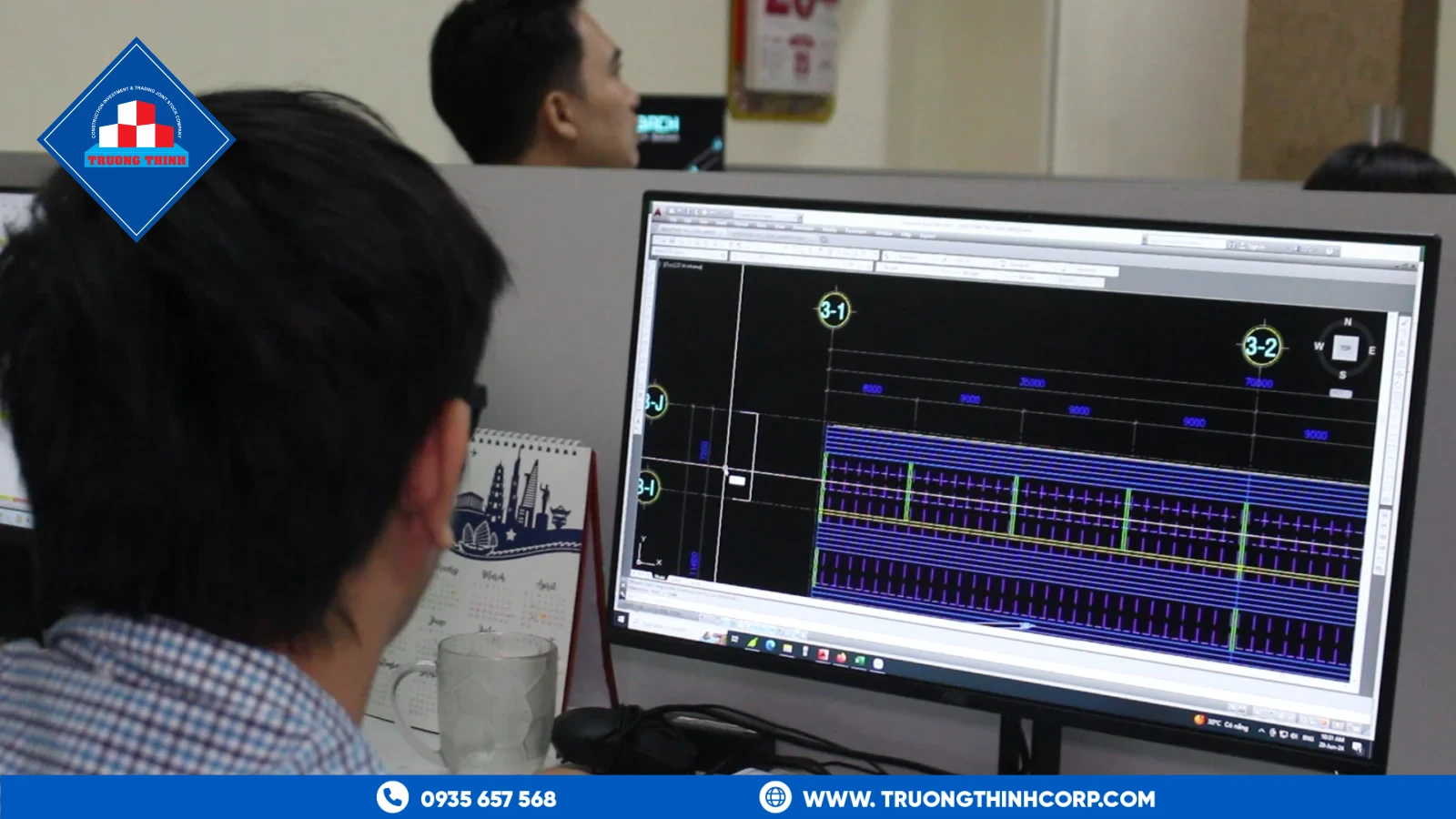
Structural design and detailing run on Tekla Structures for 3D modeling and shop-drawing extraction, SAP2000 for structural analysis, and Revit for coordination with architectural and MEP consultants, the same software stack most EPC contractors and structural engineers already use, which keeps model handoff and clash-detection fast on both sides.
Capacity and Quality Systems at a Glance
| Item | Specification |
|---|---|
| Facility area | 25,000 m² (15,000 m² workshop + 10,000 m² yard/office) |
| Fabrication capacity | 1,200–1,500 tons/month, depending on product mix |
| Quality management | ISO 9001:2015 certified |
| Welding standard | Welder qualification to a recognized welding-qualification scheme, confirmed against the project’s applicable code |
| Design software | Tekla Structures, SAP2000, Revit |
| Cutting & welding equipment | CNC plasma/laser cutting, automatic and horizontal welding lines, beam-straightening machine |
| Surface preparation | Sa 2.5 sandblasting before primer/finish coat |
| Material handling | Overhead cranes throughout the fabrication bays |
| Export markets | Southeast Asia, with Thailand and the Philippines among the nearby markets Truong Thinh is expanding into |
3. Steel Grade, Mill Certificates, and Documentation to Request
Beyond fabrication process, the raw material paper trail is where a lot of quality risk hides. Before placing an order with any steel structure supplier, ask for the steel grade being used for primary framing (typically Q235/Q345 equivalents or ASTM A36/A572 depending on the design code the project follows), the mill test certificate for each heat number, and confirmation of which structural design code governed the analysis, whether Vietnamese TCVN or an international code such as AISC or Eurocode, since load factors and connection design differ between them. Truong Thinh’s engineering team runs structural analysis in SAP2000 against whichever code the project specifies, and mill certificates are issued and retained against each production lot as part of the ISO 9001:2015 traceability requirement.
4. Planning Lead Time Around a 1,200–1,500 Ton/Month Steel Plant
A monthly capacity figure only tells you what a plant can produce at full utilization. It does not tell you your delivery date, which depends on current backlog, the complexity of your connection details, and how quickly shop drawings get approved. A useful way to pressure-test a quoted lead time is to ask for the plant’s current order book and how many tons are already committed for the months your project would occupy. A fabricator confident in its schedule will share this; one that will not is a signal to build contingency into your project float. For time-critical builds, front-loading the structural design review is usually the single biggest lever for compressing overall delivery, so Tekla shop drawings can be approved and cutting can start on the first structural package while later packages are still in detailing.
5. Manufacturer vs. Trading Supplier: Why It Matters
Many companies marketed as steel structure “suppliers” in Vietnam are trading intermediaries that subcontract fabrication to third-party workshops with no direct oversight of welding quality or schedule. Buying directly from the steel structure factory that owns the equipment and the QC process removes a layer of risk: you can request mill certificates, weld procedure specifications, and inspection reports directly from the party that did the work, and lead-time commitments are not diluted by a subcontracting margin.
Truong Thinh works both models: direct fabrication for buyers who manage their own erection, and full steel structure contractor scope for buyers who want design, fabrication, and site erection under one contract.
6. Pre-Engineered Steel Buildings vs. Conventional Steel Construction
- Speed: PEB components are shop-fabricated to exact dimensions and bolted or welded on site, cutting erection time by roughly a third to a half compared with conventional built-up steel framing.
- Weight optimization: Tapered built-up sections and engineered purlin/girt spacing reduce steel tonnage versus standard hot-rolled framing for the same span and load case.
- Clear span: PEB portal frames comfortably span 20–60 m without interior columns, which matters for warehouses, aircraft hangars, and production floors that need unobstructed floor area.
- Cost predictability: Because the frame is designed and priced as a system rather than assembled from generic sections, buyers get a firmer quotation with fewer field variations.
See our dedicated guide to pre-engineered steel building manufacturing for span tables and component breakdowns, and the steel structure components technical guide for how columns, beams, trusses, and purlins fit together in a finished frame.
7. Case Study: Multi-Sector Steel Fabrication Track Record
Truong Thinh’s fabrication history spans commercial, agro-industrial, manufacturing, and logistics projects, including the steel structure for a Co.op Mart commercial center building, the Nutreco Ha Tinh animal-feed production plant, the Royal House ceramic tile manufacturing factory, the Duy Hung Logistics warehouse, and a trade center building supplied to Phnom Penh, Cambodia. Each project required a different combination of clear span, crane-load capacity, and cladding system, which is why the design team models every job in Tekla and SAP2000 before cutting starts rather than reusing a generic template.
8. Sourcing Checklist for International Buyers of Steel Structures
- Ask for the ISO 9001:2015 certificate and the welder qualification records (a recognized welding-qualification scheme, confirmed against the project’s applicable code), not just a claim of certification.
- Request a sample shop drawing set from Tekla Structures to confirm the fabricator does its own detailing rather than outsourcing it.
- Confirm monthly fabrication capacity against your project tonnage and delivery window. A supplier quoting a specific monthly capacity should be able to show a production schedule for it, not just a number.
- Check export experience to your destination country: customs documentation, container/break-bulk packing, and prior shipments within Southeast Asia.
- Clarify whether the quote is fabrication-only or includes structural steel fabrication plus site erection.
Choosing a Steel Structure Manufacturer with Confidence
A dependable steel structure manufacturer shows its work: certified mill steel, a documented QC system, and an export track record that holds up to scrutiny before a contract is signed. Truong Thinh Corp brings all three together at its 25,000 m² Ho Chi Minh City facility, from Tekla-based detailing through ISO 9001:2015-controlled fabrication to export-ready packing, so international buyers can verify capability at every stage rather than taking a quotation on faith. Use the sourcing checklist above with any steel structure supplier under consideration, and request a fabrication quotation to compare Truong Thinh directly against the alternative.
Frequently Asked Questions
What is the difference between a steel structure manufacturer and a steel structure contractor?
A manufacturer fabricates the steel components (columns, beams, trusses, purlins) to an approved design and ships them to site. A contractor takes on broader scope that can include design, fabrication, transportation, and on-site erection under a single contract. Truong Thinh offers both; see our steel structure contractor page for the full-service scope.
How much steel structure can Truong Thinh fabricate per month?
The facility is rated for 1,200–1,500 tons of fabricated steel per month, depending on product mix, across the 15,000 m² covered workshop.
What welding standard does Truong Thinh follow?
Welders are qualified to a recognized welding-qualification scheme, confirmed against the project’s applicable code, and the facility operates under an ISO 9001:2015 quality management system covering material intake, in-process inspection, and final QC before shipment.
Which countries does Truong Thinh currently export to?
Southeast Asia is Truong Thinh’s core export market, and the company is expanding its export reach to nearby markets including Thailand and the Philippines.
Can Truong Thinh handle both fabrication-only orders and full design-build projects?
Yes. Buyers can order fabrication to their own engineered drawings, or engage the in-house team for structural steel fabrication combined with design services, structural consulting, and export logistics.